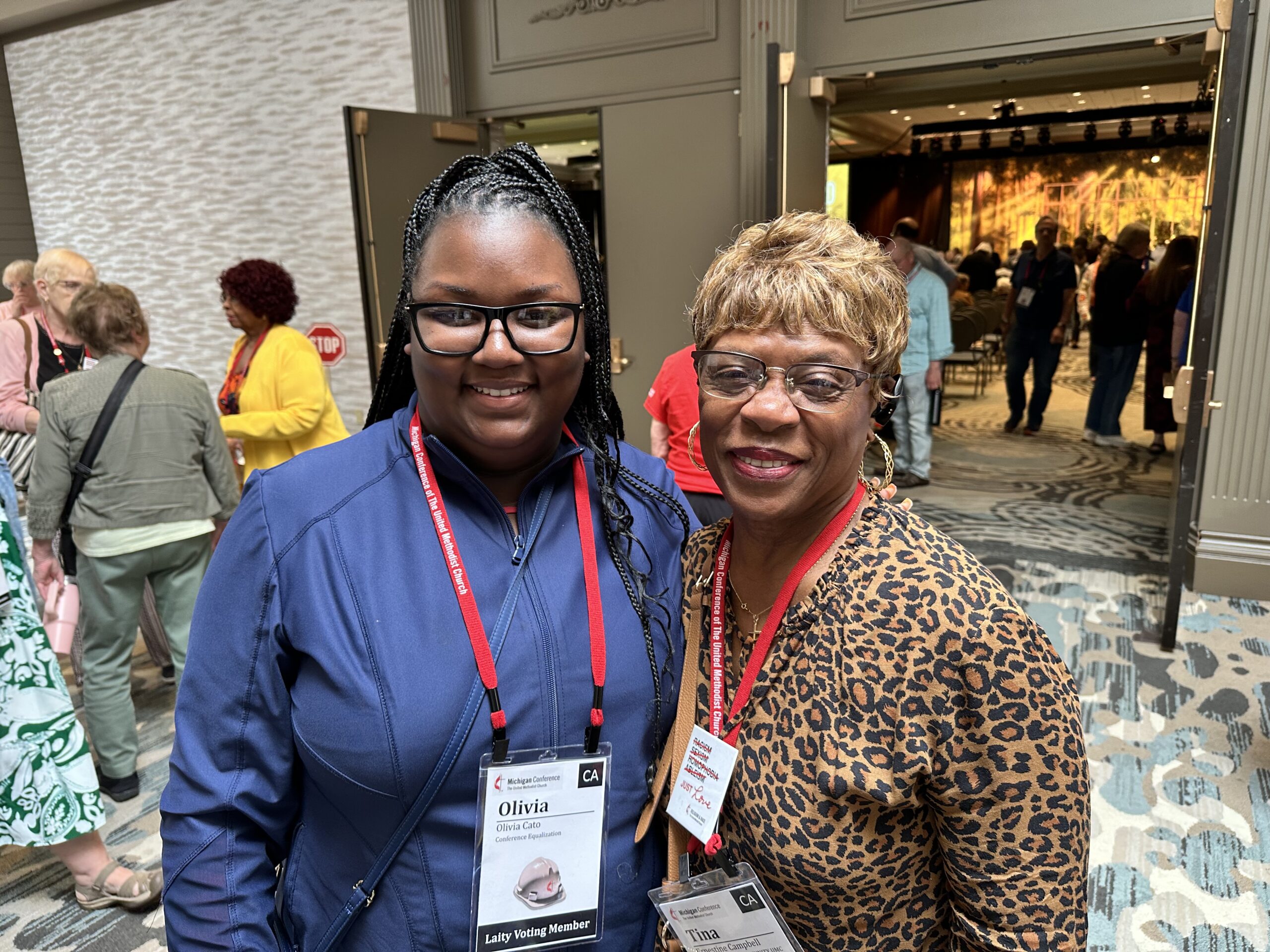
Olivia Cato (left) pictured with Tina Campbell, fellow UM, at the MIUMC Annual Conference 2025
One young adult’s path reveals the power of belonging and the impact a supportive church can have on a future.
By ADRIENNE TRUPIANO
Media Specialist, Greater Detroit District
In a time when many churches struggle to connect with young adults, 25-year-old Olivia Cato stands out as a hopeful exception. On any Sunday in the Greater Detroit District, you might find her behind a soundboard, adjusting microphones, launching livestreams, or helping a member log into Zoom for the very first time. What looks like simple tech assistance has become a ministry that shaped not only her faith but the direction of her entire life.
Olivia has been part of the United Methodist Church for more than 14 years and is now a member of Grace Community United Methodist Church in Detroit. Unlike many lifelong churchgoers who grew up in pews, Olivia found her way into the church through a friend—a path she says made her feel immediately welcomed. She remembers the first time she returned to church as an older teen after drifting away from the childhood Sundays she spent with her grandmother. “Once I came back to the church, it was just more so like, I’m back home,” she says. “The congregation made me feel home. I just knew that was the place for me to be.”
That welcome created space for something none of them expected: the beginning of a calling.
Before COVID-19, Olivia imagined a future in early childhood education. That changed when Rev. Dr. Darryl Totty introduced Zoom and phone-in options at Detroit Second Grace United Methodist Church, where she was attending at the time. The congregation wasn’t immediately excited about using new technology, but Olivia stepped in to help lead trainings alongside him. When the pandemic arrived, the need for her skills became urgent.
She began teaching church members how to use Zoom, answering countless phone calls, and even visiting homes—carefully and safely—to help people set up computers, phones, and livestream access. One member, Mrs. Willia Miller, who was 92 years young, transformed from dialing in by phone to fully participating on camera in Bible study. “To see her being able to use the device as if she was one of us younger adults—that brought me joy,” Olivia recalls.
The gratitude that poured in—voicemails, hugs, thank-yous at church—opened Olivia’s eyes to something deeper. “It encouraged me to continue to want to help throughout the district,” she says. She soon became the go-to technology support person not only for her home church but also for West Bloomfield United Methodist Church, Saint Paul United Methodist Church, and numerous district-wide events as a member of the district Marketing & Communications Committee.
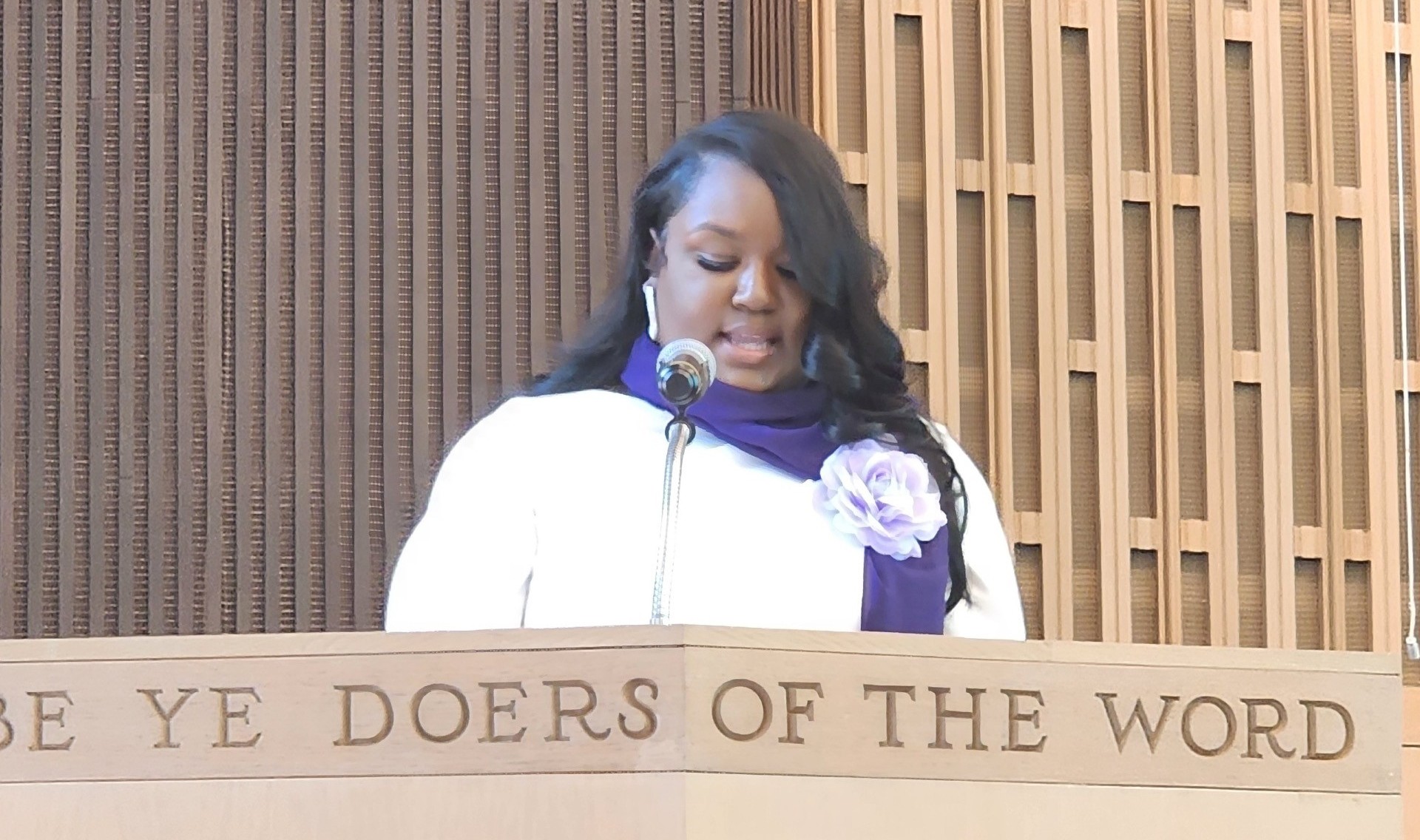
Olivia Cato speaking at Women’s Day 2025 at Grace Community UMC
What she didn’t know at the time was that this volunteer work was reshaping her future. Hosting weekly technology sessions for congregations across Detroit stirred something that early childhood education no longer matched. “I never knew that me coming in just helping with something so small—how to log onto Zoom—would take me as far as going to college for cybersecurity,” she says. That realization pushed her to enroll at Henry Ford College, where she recently graduated with a degree in cybersecurity and is continuing her studies in Applied Science. Since then, she has completed major internships, spoken at Women in Cybersecurity conferences, and served as president of her college’s Women in Cybersecurity chapter.
“If it had not been for God, I wouldn’t be where I am today,” she says firmly. That sense of calling deepened during one of the hardest seasons of her life: the loss of her mother. Even in grief, Olivia showed up for church each Sunday and kept helping others. “She was my backbone and the battery in my back,” Olivia says of her mother. “Even when I had doubt, she supported and encouraged me. And I still feel her presence.”

Olivia Cato (left) pictured with her mother, Elaine Reedus (right)
While Olivia’s story is inspiring, it also sheds light on the challenges young adults face in church settings. She has witnessed—and personally experienced—the struggles that arise when younger people bring fresh ideas and encounter resistance. “As younger people, when we come into the church and try to introduce change, some of the older congregation say, ‘Yeah, that sounds like a good idea… but we’ve been doing it this way for 20 years,’” she says. “We are the future of the church. Be open to our ideas. Make us feel like our opinions matter.”
Her experience reflects a tension felt across the Detroit area, where churches continue to hope for more young people while sometimes struggling to embrace the change young people naturally bring. Olivia believes that authenticity, relatable sermons, meaningful music, and a safe space for open conversation are key to building genuine connection. “Making young people feel comfortable confiding in the church—that’s huge,” she says.
Still, she sees hope. Messages from her pastor, the support of her congregation, and the ongoing chance to serve keep her grounded. “It keeps me hopeful that it continues to be like that throughout my journey,” she says.
As for young adults who feel drawn back to church but hesitate to walk through the doors, Olivia offers heartfelt encouragement: “Stay faithful. Give the church a chance. Open your heart and your mind. And if you walk into a church and you feel like that’s not the place for you to be, don’t be scared to go find another church. Don’t let one bad experience mess up your experience in general. The church is a good place. The church is a safe place. You just have to be patient, be loyal, be faithful—and trust the process.”
Her story is deeply personal—but it is also part of a larger movement happening across the Greater Detroit District. Rev. Dr. Darryl Totty reflects on this district-wide transformation:
“Across the Greater Detroit District, we are witnessing a fresh movement of God stirring growth, vitality, and renewed purpose in our congregations. Churches such as Beverly Hills UMC, Birmingham & Berkley First, Commerce UMC, Detroit Central UMC, First UMC Dearborn, First UMC Hazel Park, First UMC Mount Clemens, First UMC Northville, First UMC Royal Oak, French UMC, Good Shepherd UMC Dearborn, Grace Community UMC, Hope UMC Southfield, Immanuel UMC Eastpointe, Lambertville UMC, Nardin Park UMC, Novi Korean Multicultural UMC, St. Paul UMC Monroe, St. Paul Rochester, Trinity UMC Roseville, and Utica UMC are experiencing growth because they have embraced the sacred calling to make disciples with boldness, creativity, and compassion.
These congregations are demonstrating that when we lead with authenticity, radical hospitality, and a deep commitment to mission, people—especially children, youth, and young adults—are drawn to the transforming love of Jesus Christ. Young adults long for purpose, justice, community, and the opportunity to help shape something meaningful.… When the Church invites young adults into genuine community and entrusts them with significant responsibility, they do more than participate—they thrive, they lead, and they call others into the journey of discipleship.
The growth we are witnessing across the District is a testament to what God can do when we courageously step into our mission. As we continue to cultivate communities marked by grace, service, and Spirit-filled hope, I am convinced that even greater things are yet to come. ‘For we walk by faith, not by sight.’ —2 Corinthians 5:7.”
Olivia Cato’s story is one bright example of that movement: what becomes possible when a church opens its doors, listens deeply, nurtures gifts, and welcomes young adults not as the future—but as the faithful leaders of today.